|
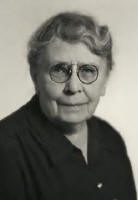
She attended the Oberlin Conservatory of Music from 1884 to 1886 and taught piano in St. Paul, Minnesota, 1887-89. Frances attended Harvard University for two years where she studied counterpoint. In 1893, inspired by the newly published A Study of Omaha Music, by Alice Cunningham Fletcher, Densmore began a ten-year preparatory period of study during which Fletcher was a teacher, mentor, and friend. She ended her formal piano performances in favor of a new career in preserving the music and culture of Native America. Frances first began recording music when
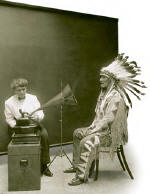
a tune hummed by Geronimo caught her attention at the 1893 Chicago World's
Fair. She recorded that tune and then went on to record the music of the
Chippewa Indians in Minnesota,. In 1895, Densmore began lecturing about
Native American music. Like many scholars of the time, Frances' lectures were
primarily based on her reading of existing sources rather than
a first-hand experience with the music. In 1905, Frances made her first visit to
a Minnesota tribe, in an Ojibwe village in the far north. She
published her observations in the American Anthropologist (April-June
1907) Frances began to record Indian music
Densmore described the Ojibwe music in two volumes published between 1910 to 1913. The Teton Sioux Music collection was published in 1918. It is among the best ethnographies of the Sioux. She also wrote The Indians and Their Music in 1926. This work brought her attention from a wide range of readers. Frances Densmore wanted listeners to
understand that all music needs to be heard and understood in its cultural
context. She also wanted to point out that Native American music does not
differ much in melody, tempo, and pitch from the Western music that is
well known in the United States. Today, Frances Densmore is well known as
a pioneer of the study of Native American music.
Frances Densmore's research consisted of three main
phases: Recording the songs and collecting related artifacts and
information from
While Densmore's research among Indian tribes was scientifically based, she managed to grasp the elusive concept of spirituality while studying healing songs, dream or personal songs, and warrior's songs. Her refusal to record the most sacred of songs illustrated her understanding and respect for Indian beliefs. Densmore was able to separate common misinterpretations of Indian songs, as a form of entertainment, from their spiritual and ceremonial nature:
As a grown man, Eagle would sing this song whenever he went to war as a source of courage and inspiration. Densmore discovered the existence of a hierarchy of songs in the tribes she studied. Songs associated with men's roles, such as warrior's songs, or healing songs, were considered more significant than, for example, a lullaby or a woman's lamenting song. Densmore did not trivialize the cultural significance of any song, and recognized each song as being part of a cultural tradition. However, she also appreciated a more romantic quality she called "the poetry of song." The following Chippewa lullaby, Densmore noted, would have been sung in a low, soothing voice, using the syllables "way, way, way" in a mesmerizing rhythm.
Lullabies and love songs did not have the spiritual impact or gravity of healing, warrior society, or other ceremonial songs, but were valued for their soothing qualities and as a form of expression. Such songs are also significant in outlining men's and women's responsibilities in Indian cultures. To analyze all of Densmore's data is a daunting task. For each song that was recorded and transcribed, Densmore produced a detailed chart of rhythm, tone, pitch, tempo and melody. She was able to formulate common characteristics for Indian music as a whole: songs usually begin with high notes and end in a low note; rhythm is more prominent than melody; and, music is based on vocal capabilities rather than on notes produced from a musical instrument. While songs were a valued part of cultural traditions, passed from one generation to the next, they were in danger of being lost: " . . . songs are rapidly passing away and are now a matter of tradition, which adds to the importance of preserving the old songs that have been handed down to the present generation, with the story of their origin." Frances Densmore's research has ensured, for future generations of Indian tribes, that traditional songs continue to be links to the past as well as celebrations of a vital present. Fortunately for us, Densmore lacked formal training as an anthropologist. She began her research as a Victorian-era amateur who composed Western harmonies to accompany the Indian songs she collected. By modern standards her attitude toward her Indian informants was at times prudish and patronizing. But over the years, Densmore matured as a researcher: her observations became increasingly focused and her views became less influenced by Western preconceptions. Her lack of training in anthropology haunted her throughout her career; she never received the acclaim or respect that she craved from the professional community. Nevertheless, Frances Densmore assembled a cultural resource that is remarkable in both scope and volume. No other individual has contributed as much to the preservation and understanding of the music of Native Americans.
http://people.mnhs.org/authors/biog_detail.cfm?PersonID=Dens195
This is a crazy world. What can be done? Amazingly, we have been mislead. We have been taught that we can control government by voting. The founder of the Rothschild dynasty, Mayer Amschel Bauer, told the secret of controlling the government of a nation over 200 years ago. He said, "Permit me to issue and control the money of a nation and I care not who makes its laws." Get the picture? Your freedom hinges first on the nation's banks and money system. That's why we advocate using the Liberty Dollar, to understand the monetary and banking system. Freedom is connected with Debt Elimination for each individual. Not only does this end personal debt, it places the people first in line as creditors to the National Debt ahead of the banks. They don't wish for you to know this. It has to do with recognizing WHO you really are in A New Beginning: A Practical Course in Miracles. You CAN take back your power and stop volunteering to pay taxes to the collection agency for the BEAST. You can take back that which is yours, always has been yours and use it to pay off your debts. And you can send others to these pages to discover what you are discovering.
Disclaimer: The
statements on www.real-dream-catchers.com have not been evaluated by the FDA.
These dream catchers are not intended to diagnose nor treat nor cure any
disease or illness
|



 Bureau of American Ethnology. The most important of these are Chippewa
Music, Chippewa Music--II, and Teton Sioux Music. Her other publications
include The American Indians and Their Music and Cheyenne and
Arapaho Music. Over her entire career, Densmore made roughly 3,500
recordings, transcribed 2,500 songs, took hundreds of photographs,
collected innumerable artifacts, wrote 15 major monographs, and published
170 articles.
Bureau of American Ethnology. The most important of these are Chippewa
Music, Chippewa Music--II, and Teton Sioux Music. Her other publications
include The American Indians and Their Music and Cheyenne and
Arapaho Music. Over her entire career, Densmore made roughly 3,500
recordings, transcribed 2,500 songs, took hundreds of photographs,
collected innumerable artifacts, wrote 15 major monographs, and published
170 articles. Indian subjects; transcribing the songs into musical
notes; and, analyzing and publishing findings. Densmore realized the
importance of collecting musical instruments, associated artifacts, and
even plants and herbs as a method of interpreting songs in their cultural
context, especially in the case of ceremonial or healing songs. She
concluded that musical instruments used by North American Indian tribes
vary greatly, as does their music. One exception-the gourd rattle-was
widely used. Densmore collected hide drums from the Sioux, plank or box
drums from Northwest Makah, flutes from the Winnebago of the Great Lakes
regions, and various types
of whistles and rattles. Although instruments were collected as meaningful artifacts, Densmore did not overemphasize the
role of instruments in comparison to music made by the Indian voice,
"Instrumental music is used only as an accompaniment to singing among the
Indians, except that the young men sometimes play a flute in the evenings
and a whistle may be blown in ceremonies or in the treatment of the sick."
In Densmore's estimation, the human voice was the most significant
"instrument."
Indian subjects; transcribing the songs into musical
notes; and, analyzing and publishing findings. Densmore realized the
importance of collecting musical instruments, associated artifacts, and
even plants and herbs as a method of interpreting songs in their cultural
context, especially in the case of ceremonial or healing songs. She
concluded that musical instruments used by North American Indian tribes
vary greatly, as does their music. One exception-the gourd rattle-was
widely used. Densmore collected hide drums from the Sioux, plank or box
drums from Northwest Makah, flutes from the Winnebago of the Great Lakes
regions, and various types
of whistles and rattles. Although instruments were collected as meaningful artifacts, Densmore did not overemphasize the
role of instruments in comparison to music made by the Indian voice,
"Instrumental music is used only as an accompaniment to singing among the
Indians, except that the young men sometimes play a flute in the evenings
and a whistle may be blown in ceremonies or in the treatment of the sick."
In Densmore's estimation, the human voice was the most significant
"instrument." 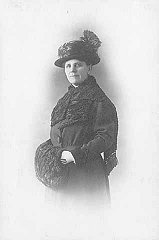 In her article "The Belief of the Indian in a
Connection Between Song and the Supernatural," Densmore articulately
interpreted the Indian concepts of spirits and dreams in relation to
songs. While songs in many cultures are written to or for a deity, Indian
songs are received from spirits through dreams, or visions. When a song is
transferred in this manner, it becomes the recipient's possession, or
"personal song." A moving example is a personal song recorded by Densmore
while she was working with the Pawnee. As a boy, a warrior named Eagle was
frightened of thunder. The thunder spoke to him in a dream and told him
not to be afraid. The warrior remembered the thunder's song, which became
his own:
In her article "The Belief of the Indian in a
Connection Between Song and the Supernatural," Densmore articulately
interpreted the Indian concepts of spirits and dreams in relation to
songs. While songs in many cultures are written to or for a deity, Indian
songs are received from spirits through dreams, or visions. When a song is
transferred in this manner, it becomes the recipient's possession, or
"personal song." A moving example is a personal song recorded by Densmore
while she was working with the Pawnee. As a boy, a warrior named Eagle was
frightened of thunder. The thunder spoke to him in a dream and told him
not to be afraid. The warrior remembered the thunder's song, which became
his own:

 Get
a course to promote your business online, explode your sales
Get
a course to promote your business online, explode your sales Get
software to promote your business online in less time
Get
software to promote your business online in less time Get
software to streamline your business and run it hands free.
Get
software to streamline your business and run it hands free.