Interpreting the Ojibwe  Pictographs of North Hegman Lake, MN

Dream-Catchers of the Seventh Fire   Soar Home with the wisdom of real dream-catchers
Dream-Catchers Home
History of Dream-Catchers
Gallery of Dream-Catchers
Dream-Catcher Kits
Weaving a Dream-Catcher
Order Dream-Catchers
Seventh Fire Prophecy-Protest-Principle
History of the Little Shell Band of Ojibwe
History of the Ojibways
Ojibwe Culture and Language
Native American Holocaust
Native American Medicine
Natural Serotonin
Pycnogenol

Photo Galleries Index
The Littlest Acorn
Stories Dream-Catchers Weave
Creating Turtle Island
Sage Ceremony for Dream-Catchers
Larry Cloud-Morgan
White Eagle Soaring
Seventh Fire Blog
Real Dream Catchers' links
Comments about these Dream-Catchers

Spider Web Dream-Catcher of the Seventh Fire DreamCatcher Heritage Collection

Heart Dreams Dream-Catcher Necklace of the Seventh Fire DreamCatcher Collection

Path of the Spirit Dream-Catcher of the Seventh Fire DreamCatcher Heritage Collection

Real Dream-Catchers teach spirit wisdoms of the Seventh Fire

Real Dream-Catchers teach the wisdoms of the Seventh Fire, an Ojibwe Prophecy, that is being fulfilled at this moment. The Light-skinned Race is being shown the result of the Way of the Mind and the possibilities that reside in the Path of the Spirit. Real Dream-Catchers point the way.

Abstract

The arrangement of figures at the main panel of the North Hegman Lake, Minnesota rock art site appears to have been carefully composed at one time by one rock artist. Its present excellent condition suggests either that it may not be especially old or that it is a site where an older pictograph has been repainted. The rock art appears to represent Ojibwe meridian constellations visible in winter during the early evening, knowledge of which may have been useful for navigating in the deep woods during the winter hunting season. Support for a suggested multi-layered interpretive model comes from a review of various culturally specific ethnohistorical sources. The inclusion of elements from widely known Ojibwe legends and references to constellations with cosmological or religious significance make it an intriguing scene with many interesting culturally specific referents. This panel is perhaps the most visited and photogenic pictograph within the State of Minnesota and it possesses remarkable artistic merit.


Indian Tribes and Termination

Tracing the Path of Violence: The Boarding School Experience

Ojibwe Art and Dance

Ojibwe Forestry and Resource Management

Ojibwe Homes

Ojibwe Honor Creation, the Elders and Future Generations

Ojibwe Indian Reservations and Trust Land

Ojibwe Language

Ojibwe Snowshoes and the Fur Trade

Ojibwe Sovereignty and the Casinos

Ojibwe Spirituality and Kinship

Ojibwe Tobacco and Pipes

Traditional Ojibwe Entertainment

Myth of the Ten Lost Tribes of Israel - 2 - 3 - 4

Soul of the Indian: Foreword

The Great Mystery - 2
The Family Altar - 2
Ceremonial and Symbolic Worship - 2
Barbarism and the Moral Code - 2
The Unwritten Scriptures - 2

On the Borderland of Spirits - 2

Charles Alexander Eastman

Pycnogenol is a super-antioxidant sourced through Native American medicineMaritime Pine Pycnogenol  is the super-antioxidant that has been tried and tested by over 30 years of research for many acute and chronic disorders. The Ojibwe knew about it almost 500 years ago.  Didn't call it that, though. White man took credit.

Seroctin--the natural serotonin enhancer to reduce  stress and depression, and  enjoy better sleep

Plant by Nature is Organic Gardening Nature's Way

Accelerated Mortgage Pay-off can help you own your home in half to one third the time and save many thousands of dollars.

Photo Gallery

Traditional Life of the Ojibwe Aurora Village Yellowknife
The Making of a Man
Little Dancer in the Circle

Friends in the Circle
Grass Dancer
Shawl Dancers
Jingle Dress Dancers

Fancy Shawl Dancer
Men Traditional Dancers
Powwow: The Good Red Road

Crater Lake Photo Gallery
Crater Lake Landscape

Flowers of Crater Lake
Birds & Animals of Crater Lake
Gold Mantled Ground Squirrel
The Rogue River

Sacred Fire of the Modoc
Harris Beach Brookings Oregon

Listen to
American Indian Radio
while you surf 

Willow animal effigies by Bill Ott after relics found in the Southwest Archaic CultureMuseum-quality willow animal effigies of the Southwest Archaic culture, art from a 4,000 year-old tradition by Bill Ott

Columbus exposed as iron-fisted tyrant who tortured his slaves

Columbus Day -The white man’s myth and the Redman's Holocaust

Excerpt from The Destruction of the Indies by Las Casas

Massacre at Sand Creek

Wounded Knee Hearing Testimony

The Wallum Olum: a Pictographic History of the Lenni Lenape, Root Tribe from which the Ojibwe arose

A Migration Legend of the Delaware Tribe 

Wallum Olum: The Deluge - Part II

Winter Count: History Seen from a Native American Tradition - 2 - 3

Ojibwe Creation Story

Paleo-American Origins

The Story of the Opposition on the Road to Extinction: Protest Camp in Minneapolis

Who Deems What Is Sacred?

Savage Police Brutality vs Nonviolence of the People

Mendota Sacred Sites - Affidavit of Larry Cloud-Morgan

Cloud-Morgan, Catholic activist, buried with his peace pipe

Interpreting the Pictographs of North Hegman Lake, MN

Kevin L. Callahan

Department of Anthropology

University of Minnesota

Introduction
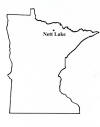
Some of the best known and most photographed pictographs in the Upper Midwest are located at North Hegman Lake, northwest of Ely, MN, in the Boundary Waters Canoe Area Wilderness on a granite cliff overlooking the water. This rock art is located within the "northern woodlands" stylistic rock art region of Campbell Grant (1983) and Klaus Wellmann (1979).

The panel shows a human figure in an outstretched arms posture standing near a quadruped animal with a long tail, possibly a dog or wolf, and a remarkably well drawn bull moose with splayed hooves and dew claws. (A dew claw on a moose is a reduced hind toe or the false rudimentary hoof above the true hoof .) Beneath these figures is a long horizontal line, probably representing the ground or horizon, and above the human figure are two vertical rows of short horizontal lines or dashes. One set has 4 lines and next to it are 3 lines. Above and to the right are what look like three canoes. The top two canoes have two paddlers and the third has a faint single one in the middle. Above the moose's rack is a single mark. Above all of these figures is a large cross like a "plus" sign.

Several feet to the left of the scene are other much more faint pictographs including 6 horizontal lines, one above the other, three crosses above each other, and a "Y" shaped figure with a "C" shape to it with diagonal strokes. There may also be a spiral and grid-like figure near the water.

The arrangement of figures at the main panel of the North Hegman Lake, Minnesota rock art site appears to have been carefully composed at one time by one rock artist. After examining the pictographs from about a foot away, it appears that the application of the red ochre was relatively recent, since it hardly looks weathered compared to other similar red ochre pictographs in northern Minnesota. It is also possible that someone has carefully reapplied ochre to a much older pictograph.

Although experiments have shown that red ochre on a rock face can become sealed through natural processes and remain quite bright even when very old, I saw no particular indication from looking at the panel up close that it was naturally encapsulated or sealed; however, I have not viewed it under magnification nor conducted any sort of microscopic examination of the surface.

The most likely candidates for the cultural groups who were making red ochre pictographs with these kinds of figures during the historical period were the Ojibwe and Cree. Other similar sites in the region have been investigated by researchers like Thor Conway (1993), Selwyn Dewdney and Kenneth Kidd (1973), Henry R. Schoolcraft (1851), Grace Rajnovich (1994) and others. Most of the other recent red ochre pictographs in this area appear to have been made by Ojibwe individuals who were recording shamanistic dreams and visions and Ojibwe leaders who were recording their biographical exploits.

The panel's anthropomorphic figure is painted with an "outstretched arms" posture rather than an "upraised arms" posture. Henry R. Schoolcraft, an Indian Agent whose wife was half Ojibwe and whose mother-in-law was a full-blood Ojibwe, authored a multi-volume work called Historical and Statistical Information . . . of the Indian tribes of the United States published in 1851. According to Schoolcraft, in pictographic inscriptions used in hunting, an anthropomorph with upraised and outstretched arms "depicts a Meda [shaman]. He is about to open his performances, and appeals to the candor and sympathy of his fellows.

. . . Behold me, Medas, my friends. Unishenauba (or the common people.) Question me my friends (Schoolcraft 1851:vol.1:383-384).

According to Schoolcraft, in Ojibwe birch bark scroll pictography "friendship [is shown] by an open hand" (Schoolcraft 1851: vol.1:420).

An upraised arm posture was a widely known position of prayer assumed by Native Americans in many areas of North America. According to Albert Reagan (1958), the Indian Agent at Nett Lake, Minnesota from 1909-1914, it was also associated with a dance posture of Ojibwe medicine men and women, especially when the legs were slightly bent. It also can mean supernatural being.

Selwyn Dewdney and Kenneth E. Kidd (1973) in their book Indian Rock

Paintings of the Great Lakes described a huge, detached slab of granite below the Hegman Lake pictographs, which produced a dull hollow sound when tapped with a rock.

Sound may have been a component in the selection of rock art sites in Minnesota. For example, in describing the petroglyphs at Nett Lake in northern Minnesota, Albert B. Reagan reported that Spirit Island or "Picture Island," where the petroglyphs were located, was also sometimes called "Drum Island" by the Ojibwe because "the polished rock area is hollow beneath; and, on walking over it, it gives out a hollow drum-like sound" (Reagan 1958).

A review of culturally specific ethnohistoric sources, analysis of the rock art, and specific information about the night sky suggest that this panel probably represents an accurate drawing of the Ojibwe winter constellation. Like the Ptolemaic system of constellations, Ojibwe constellations had many rich associations with stories, myths, and legends.

1 - 2 - 3 - 4 - 5 - 6

White Eagle Soaring: Dream Dancer of the 7th Fire

 

American Gold and Silver Currency is Back. Click here for the Liberty Dollar at a Discount.


See Real Dream Catchers' links

This is a crazy world. What can be done? Amazingly, we have been mislead. We have been taught that we can control government by voting. The founder of the Rothschild dynasty, Mayer Amschel Bauer, told the secret of controlling the government of a nation over 200 years ago. He said, "Permit me to issue and control the money of a nation and I care not who makes its laws." Get the picture? Your freedom hinges first on the nation's banks and money system. That's why we advocate using the Liberty Dollar, to understand the monetary and banking system. Freedom is connected with Debt Elimination for each individual. Not only does this end personal debt, it places the people first in line as creditors to the National Debt ahead of the banks. They don't wish for you to know this. It has to do with recognizing WHO you really are in A New Beginning: A Practical Course in Miracles. You CAN take back your power and stop volunteering to pay taxes to the collection agency for the BEAST. You can take back that which is yours, always has been yours and use it to pay off your debts. And you can send others to these pages to discover what you are discovering.

Get a course to promote your business online, explode your sales

Get software to promote your business online in less time

Get software to streamline your business and run it hands free.

Disclaimer: The statements on www.real-dream-catchers.com  have not been evaluated by the FDA. These dream catchers are not intended to diagnose nor treat nor cure any disease or illness

© 2007,  Allen Aslan Heart / White Eagle Soaring of the Little Shell Pembina Band, a Treaty Tribe of the Ojibwe Nation